Mike Nesbit 《MEASURED RESOLVE》
Mike Nesbit | 2026.09.02 (수) ~ 2026.09.30 (수)
MIKE NESBIT
MEASURED RESOLVE
CONSTRUCTION AS METHOD
건설이라는 방법
Mike Nesbit’s practice begins where painting ceases to be understood simply as an image applied to a plane. Trained in architecture and shaped by professional experience in the field, Nesbit does not represent construction as a subject. He activates it as a method. Concrete, timber, plywood, formwork, tools, sequences of labor, and the physical conditions of a site become the means through which painting is produced.
Within this practice, construction is neither a motif nor a metaphor imposed upon the work after the fact. It is an operative structure. Materials are cut, assembled, positioned, pressed, and allowed to register gravity, resistance, pressure, and time. A painting may begin on the floor rather than the wall; a tool may participate in its making before returning as a sculptural object; the architecture of the exhibition space may alter the course of production itself. Painting emerges through these procedures as a material and spatial event.
마이크 네스빗에게 회화는 평면 위에 이미지를 얹는 일로 한정되지 않는다. 건축을 전공하고 실무를 경험한 그는 건설을 작품의 소재로 묘사하기보다, 건설에서 사용하는 재료와 도구, 제작의 순서와 노동의 시간을 회화가 만들어지는 방법으로 끌어들인다. 콘크리트와 목재, 합판과 거푸집, 사다리와 손수레는 완성된 이미지를 위한 배경이 아니라 작품의 형태와 표면을 직접 만들어내는 조건이 된다.
MEASURED / RESOLVE
측정과 결의
The title MEASURED RESOLVE names the two closely connected dispositions that guide this process. “Measured” refers less to numerical precision alone than to an embodied form of calibration: the artist’s capacity to gauge weight, distance, tension, balance, and resistance through physical contact with materials and space. Measurement begins in the body, before it is translated into a dimension or a plan. It is an immediate judgment made through the hand, the eye, and the movement of the body in relation to what is being built.
“Resolve,” in turn, suggests both determination and decision. It describes the commitment required to carry a work forward, but also the judgment involved in deciding where that work should stop. For Nesbit, completion is not the faithful execution of a predetermined image. It is a provisional condition reached through continuous negotiation—between intention and material response, control and contingency, what has been planned and what the site makes newly visible.
《MEASURED RESOLVE》는 이 과정에서 작동하는 두 가지 태도를 함께 가리킨다. 여기서 ‘Measured’는 설계도에 기입된 정확한 치수만을 의미하지 않는다. 작가가 재료와 공간 앞에서 먼저 몸으로 느끼고, 손과 시선으로 무게와 간격, 압력과 균형을 가늠하며 내리는 즉각적인 측정에 가깝다. 계획과 규율은 작업을 시작하게 하지만, 모든 결정이 사전에 고정되어 있는 것은 아니다.
‘Resolve’는 주어진 조건 속에서 작업을 계속 밀고 나가는 결의인 동시에, 어디까지 진행하고 어느 지점에서 멈출 것인지를 판단하는 과정이다. 네스빗에게 완성이란 처음 세운 계획을 그대로 실현하는 일이 아니다. 재료가 보이는 반응과 현장에서 발견된 조건을 받아들이며, 작업이 도달할 수 있는 하나의 상태를 결정하는 일이다. 따라서 《MEASURED RESOLVE》는 계획과 우연, 통제와 반응 가운데 형태를 찾아가는 작가의 제작 방식을 드러내는 제목이다.
TOOLS BECOME STRUCTURES
도구가 구조가 될 때
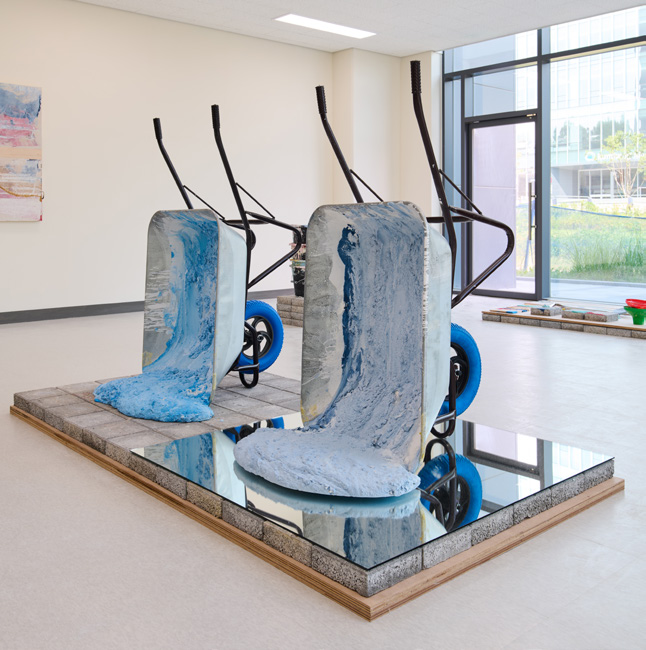
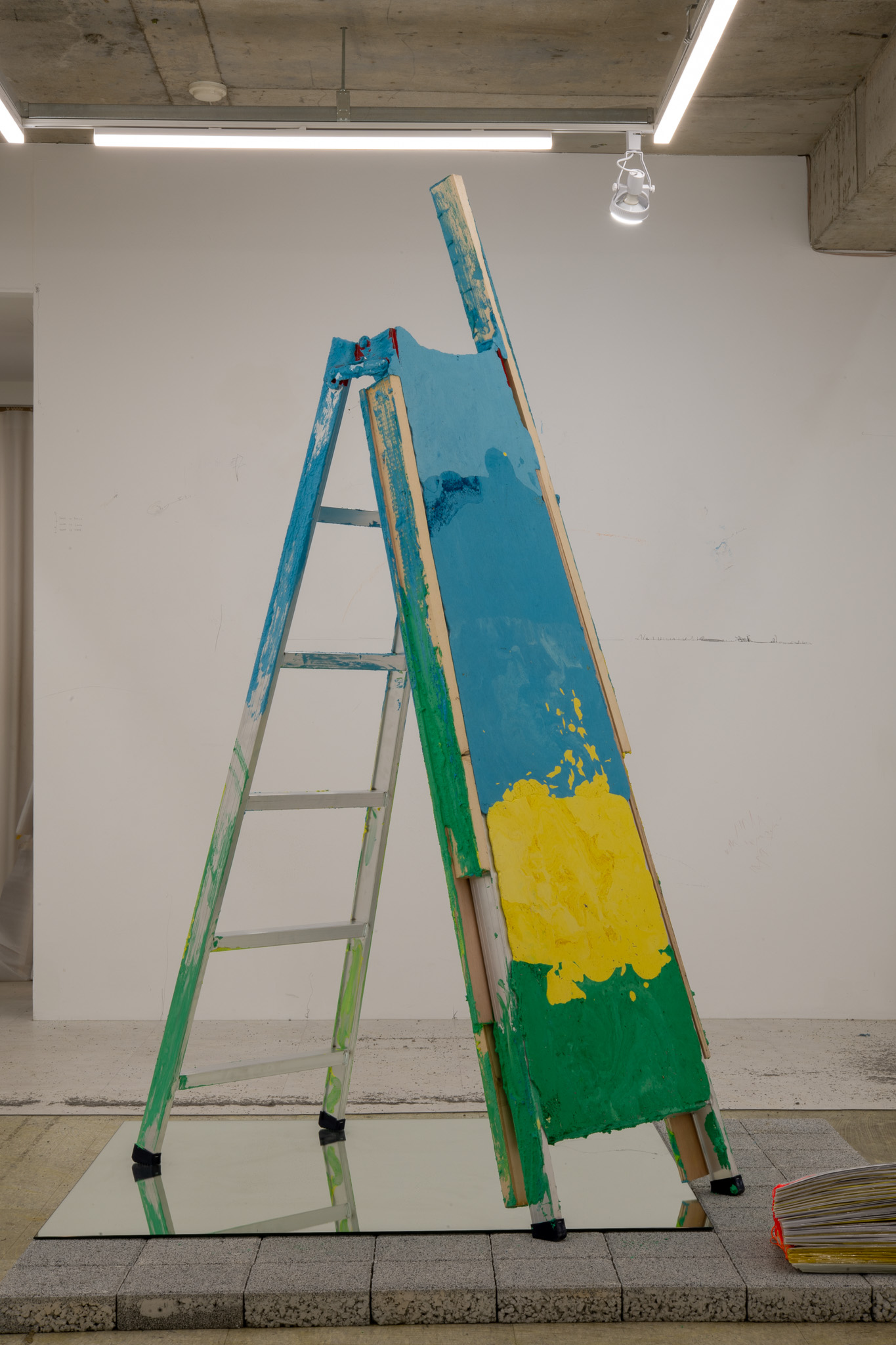
The exhibition begins with two sculptures organized around objects associated with construction labor: an A-frame ladder and a wheelbarrow. In Stairway to Heaven, For Giotto, the ladder enters into a structure of concrete and acrylic, hardwood and plywood, mirror, and concrete blocks. In Billow of Dreams, the wheelbarrow is held in relation to concrete, acrylic, mirror, and block. Neither object functions as a symbolic representation of labor, nor as a prop introduced to illustrate an idea. Each remains materially connected to the processes of carrying, supporting, reaching, balancing, and building.
The ladder establishes a vertical trajectory, directing the eye upward while retaining the practical scale of the body that would climb it. The wheelbarrow keeps weight close to the ground, holding material in a condition between transport and rest. Mirrors interrupt the stability of both structures. They fold the surrounding architecture, the other works, and the moving body of the viewer into the installation, producing a field in which actual and reflected surfaces cannot be experienced separately.
이번 전시는 사다리와 손수레를 구조로 삼은 두 점의 조각에서 출발한다. 《Stairway to Heaven, For Giotto》와 《Billow of Dreams》에서 사다리와 손수레는 건설 노동을 상징하는 소품이 아니다. 그것들은 실제 제작 과정에 참여하는 도구이면서, 동시에 콘크리트와 아크릴, 목재와 합판, 거울과 콘크리트 블록 사이의 관계를 조직하는 조각적 구조가 된다.
사다리는 위를 향해 뻗으며 공간에 수직의 방향을 만들고, 손수레는 재료의 무게를 낮은 위치에 붙잡아 둔다. 거울은 작품의 앞과 뒤, 실제 표면과 반사된 표면을 한 시야 안에 겹친다. 관람객의 몸과 움직임 역시 거울을 통해 작품의 장면 안으로 들어온다. 각각의 요소는 독립된 오브제로 고립되기보다 서로의 크기와 무게, 방향과 위치를 결정하는 관계 속에서 작동한다.
FROM FLOOR TO WALL
바닥에서 벽으로
These sculptures do not remain autonomous objects. Their orientation, scale, and material weight establish the conditions from which the site-produced painting Vertical Easement emerges. The relationship is not one of sculpture being converted into painting. Rather, painting arises from the objects and procedures through which the sculptures are constructed.
Vertical Easement was made horizontally on the gallery floor. A timber framework was assembled within the exhibition space, with plywood serving as its support. Concrete, acrylic, and hardwood were worked into this horizontal field before the completed structure was raised and installed vertically. The distinction is important: the painting is not adequately described as having been simply “cast” or “poured.” Its form results from a larger sequence of construction—framing, positioning, layering, registering, lifting, and reorientation.
During production, the ladder and wheelbarrow were placed upon the horizontal surface. Their forms remain registered within the finished field as images. The objects that help produce the work therefore occupy more than one condition: they are tools, physical structures, sculptural presences, and sources of painterly form. Once the painting is raised vertically, the movement from floor to wall transforms these material encounters into a pictorial surface without concealing the process that generated them.
The painting does not depict the sculptures. It retains the effects of their contact.
Through this movement, the conventional separation between the object and its image becomes unstable. The ladder and wheelbarrow stand in the gallery as sculptures while also persisting within Vertical Easement as traces. The work’s imagery is not projected onto the surface from elsewhere; it is produced by the physical relationships that occurred during construction. Image and object belong to the same sequence of actions.
전시장에서 현장 제작된 《Vertical Easement》는 이 두 조각과 별개의 회화가 아니다. 전시장 바닥에 목재 프레임을 구축하고 그 안에 합판을 지지체로 놓은 뒤, 콘크리트와 아크릴, 하드우드를 사용해 수평 상태에서 제작하고 완성된 화면을 수직으로 세운 작업이다. 이는 회화를 ‘콘크리트로 부어 만든 그림’이라고 단순화할 수 없는 이유이기도 하다. 작품의 핵심은 특정 재료를 타설했다는 사실보다, 조각을 구축해 온 사물과 제작 방식이 어떻게 회화적 결과로 이어지는가에 있다.
제작 과정에서 사다리와 손수레는 화면 위에 놓였고, 그 윤곽과 흔적은 표면 안에 이미지로 남았다. 조각을 만들기 위해 사용된 도구가 회화의 형상을 만들고, 그 도구는 다시 전시장 안에서 조각으로 제시된다. 이처럼 《Vertical Easement》에서는 제작 도구와 작품, 조각과 회화, 과정과 결과의 구분이 서로를 넘나든다. 회화는 조각 이후에 덧붙여진 것이 아니라, 조각을 구축하는 과정 안에서 발생한다.
THE DECISION TO STOP
멈춤이라는 결정
The gallery floor became another site of negotiation. Nesbit initially intended to remove selected areas of the existing tile finish in order to reach the concrete beneath. As the upper layer was opened, however, an earlier tile surface was discovered below it. Rather than continuing to the originally planned depth, the artist chose to stop at the newly exposed layer.
This decision is central to the exhibition. The significance of the intervention lies not in the extent of demolition, but in the recognition of a condition that had not been anticipated. The older tile does not appear as a failure to reach the intended surface. It marks the point at which the site asserted its own material history and redirected the work.
To stop, in this context, is not to abandon the process. It is to complete a decision.
The exposed floor records a moment when a plan yielded to evidence. What was already present within the building became more consequential than what had been projected onto it. “Resolve” therefore acquires a precise material form: it is the judgment that determines how far an intervention should proceed and the point at which discovery must be allowed to remain visible.
바닥에 대한 개입 역시 이러한 현장 판단을 보여준다. 작가는 전시장 바닥의 타일 마감을 선택적으로 제거해 그 아래의 콘크리트 구조를 드러내려 했다. 그러나 현재의 타일층을 걷어내는 과정에서 예상하지 못했던 더 오래된 타일층이 발견되었다. 작가는 처음 계획한 깊이까지 작업을 강행하지 않고 그 지점에서 멈추었다.
이 결정에서 중요한 것은 바닥을 얼마나 많이 철거했는가가 아니다. 이미 그곳에 존재하고 있던 층을 발견하고, 그 발견이 요구하는 새로운 한계를 받아들였다는 데 있다. 드러난 이전 타일층은 계획이 실패한 흔적이 아니라, 계획이 현장의 조건과 만나 수정된 기록이다. 작업을 계속하는 것만큼 멈추는 것 역시 하나의 제작 행위가 된다. 전시 제목의 ‘Resolve’는 바로 이처럼 현장의 조건을 읽고 작업이 도달할 지점을 결정하는 순간에 구체적인 의미를 얻는다.
PROCESS BECOMES FINISH
과정이 마감이 될 때
Nesbit’s works preserve such decisions rather than concealing them beneath the appearance of completion. Impressions from the timber framework, residual material, shifts caused by gravity and pressure, and traces of the tools used in production remain present in the finished works. Labor does not disappear behind a resolved surface. It becomes the surface.
As Nesbit states, “Process becomes finish, and finish becomes process.” The phrase describes a recursive structure at the center of his practice. The procedures that produce a work remain legible as its finish, while every finished condition becomes the basis for another action, placement, or encounter. Completion is not an endpoint but a temporary organization of materials and forces.
네스빗은 “Process becomes finish, and finish becomes process”라고 말한다. 과정은 마감이 되고, 마감은 다시 다음 과정을 위한 조건이 된다. 목재 프레임의 자국과 재료의 잔여물, 중력과 압력에 의해 생긴 흔적, 제작에 사용된 사물과 현장에서 내려진 판단은 완성 이후에도 지워지지 않는다. 작품은 제작 과정을 감춘 매끈한 결과물이 아니라, 그것이 어떻게 만들어졌는지를 계속 드러내는 표면이 된다.
COLLECTIVE PRODUCTION
협업과 제작의 구조
The production and installation of MEASURED RESOLVE were developed in collaboration with Haenglim Architects & Engineers. This collaboration is integral to the material logic of the exhibition. In a practice that brings timber frameworks, concrete, large structures, tools, and architectural conditions into a single field of production, fabrication and installation cannot be treated merely as technical stages that follow artistic conception.
Haenglim’s involvement enabled the artist’s propositions to be worked through at the scale, weight, and sequence demanded by the site. The collaboration formed a practical bridge between plan and execution, while remaining open to the adjustments required by the materials and by the gallery itself. Because Nesbit’s practice locates meaning within acts of making, the labor and coordination through which the exhibition was realized belong to its conceptual as well as its physical structure.
이번 전시의 제작과 설치에는 행림종합건축사사무소(Haenglim Architects & Engineers)가 협력했다. 목재 프레임과 콘크리트, 대형 구조물과 전시장 공간을 함께 다루는 작업에서 제작과 설치는 완성된 작품 뒤로 사라지는 부수적인 단계가 아니다. 작가의 구상을 실제 크기와 무게, 재료와 작업 순서로 전환하는 과정 자체가 작품의 형성에 참여한다.
따라서 행림과의 협력은 이미 완성된 작품을 전시장에 배치하기 위한 기술적 지원에 머물지 않는다. 설계와 제작, 현장 판단과 설치가 분리되지 않는 네스빗의 작업이 서울의 구체적인 공간 안에서 실현될 수 있도록 한 제작 구조의 일부이다. 한 사람의 손만으로 환원되지 않는 노동과 협업의 시간 역시 작품의 표면과 공간 안에 남는다.
A CONTINUING MATERIAL LOGIC
이어지는 물질의 논리
MEASURED RESOLVE extends questions developed through Nesbit’s earlier projects in Korea. In Pour Tomorrow, presented in Seoul in 2025, formwork operated as both a means of production and an object in its own right. A temporary structure conventionally expected to disappear after construction was repositioned as an active component of painting and sculpture. The possibility that concrete might never arrive left the formwork suspended between preparation and completion.
In Built Like Us, presented at Seobo Art Space in Jeju in 2026, panels, tools, concrete, and residual materials were organized as an interconnected system rather than a collection of discrete works. Concrete was approached before its apparent resolution—as a receptive surface capable of recording pressure, environment, touch, and time. What was built and what remained from building were treated as parts of the same material continuum.
MEASURED RESOLVE is neither a transfer nor a reconstruction of those exhibitions. It brings their material questions into the specific architectural conditions of UM GALLERY. Here, the logic of formwork and the relation between tools, residue, and surface are reorganized through the ladder, the wheelbarrow, the mirrors, the floor, and the production of Vertical Easement. The gallery is not simply a container into which these works have been placed. Its surfaces, limits, concealed layers, light, and circulation participate in determining what the exhibition becomes.
《MEASURED RESOLVE》는 네스빗이 서울에서 선보인 《Pour Tomorrow》(2025), 그리고 제주 Seobo Art Space에서 열린 《Built Like Us》(2026)와 이어진다. 《Pour Tomorrow》에서 거푸집은 콘크리트를 위한 임시 구조물이면서 동시에 그 자체로 회화와 조각의 관계를 조직하는 사물이 되었다. 《Built Like Us》에서는 패널과 도구, 제작 뒤에 남은 잔여물이 개별 작품의 위계를 벗어나 하나의 물질적 체계를 이루었다. 콘크리트 역시 고정되고 완결된 구조체가 아니라 시간과 압력, 환경과 손의 흔적을 받아들이는 표면으로 다뤄졌다.
그러나 《MEASURED RESOLVE》는 앞선 전시의 작품을 서울로 옮겨오거나 동일한 구성을 반복하는 전시가 아니다. 앞선 작업에서 이어진 재료와 제작의 논리가 UM GALLERY의 바닥과 벽, 빛과 동선이라는 새로운 조건과 만나 다른 형태로 전개된 결과이다. 이번에는 사다리와 손수레가 조각인 동시에 회화의 형상을 만드는 도구가 되고, 현장에서 발견된 바닥의 이전 타일층은 계획을 수정하게 하는 조건이 된다. 그 과정에서 초기 구상에 없었던 회화 《Vertical Easement》가 전시의 중심적인 관계를 형성한다.
THE VIEWER AS MEASURE
관람객이라는 또 하나의 척도
The viewer encounters this field by moving through it. The works are not perceived only from a fixed position or as isolated objects. Sight rises along the ladder and returns toward the weight of the wheelbarrow and concrete blocks. Mirrors redirect attention across the room, placing actual and reflected surfaces into unstable alignment. Vertical Easement holds the traces of objects that remain physically present elsewhere in the space. The floor preserves the point at which excavation was deliberately arrested.
Through these relationships, the exhibition continuously shifts between horizontal and vertical, weight and reflection, support and image, construction and display. The viewer’s body becomes another measure within the installation, testing distance, scale, orientation, and passage.
MEASURED RESOLVE does not present a singular, fully concluded scene. It proposes painting as something built through material, force, labor, architecture, and collective production. Painting is no longer confined to the object mounted on the wall. It exists across the framework that shaped it, the tools that entered its surface, the floor that interrupted its plan, the labor that enabled its construction, and the bodies that move among its parts.
What appears finished is therefore only one moment within a continuing process of measurement and decision—a form arrived at not because every uncertainty has been eliminated, but because material, site, and judgment have, for the present, found their point of resolve.
관람객은 각각의 작품을 분리해 바라보기보다 그 사이를 걸으며 수평과 수직, 무게와 반사, 실제 표면과 비친 표면의 관계를 경험하게 된다. 시선은 사다리를 따라 위로 이동하고, 손수레와 콘크리트의 무게를 따라 다시 바닥으로 내려온다. 거울과 빛은 작품의 경계를 주변 공간으로 확장하고, 관람객의 움직임에 따라 전시의 장면을 계속 새롭게 구성한다.
《MEASURED RESOLVE》는 하나의 완결된 장면을 제시하는 전시가 아니다. 그것은 회화가 재료와 힘, 노동과 시간, 건축과 협업 속에서 어떻게 구축될 수 있는지를 보여준다. 여기에서 회화는 벽에 걸리는 순간 완성되는 이미지가 아니라, 측정하고 만들고 발견하고 멈추는 모든 판단이 잠정적으로 도달한 하나의 상태이다.
Production and Installation Support: Haenglim Architects & Engineers